LAKE LEVEL UPDATE
Written by Clyde Morris, Director
Published on March 12th, 2026
WATER LEVELS DON’T LOOK PROMISING – BUT MAY BE GETTING BETTER!
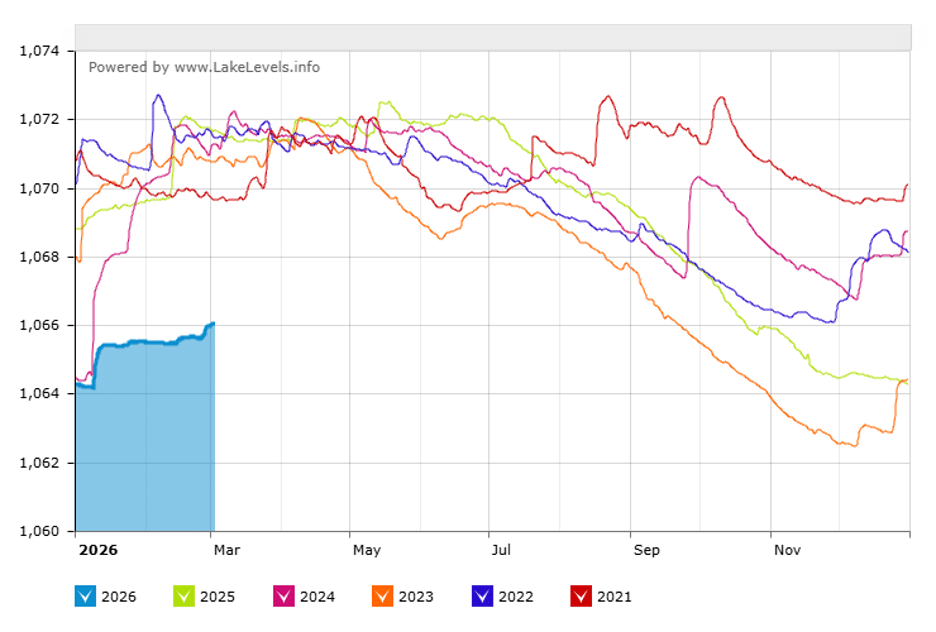
One look at the shoreline will tell you that we’re starting Spring with water levels far below what we’ve become accustomed to over the last six years. As you can see from the following chart, lake levels stayed fairly constant from March 1 through April over that time – and then started falling. In some years, like 2025, the lake stays higher for longer, and occasionally – like in 2023 – it will even rise during the last six months of the year. But not usually.
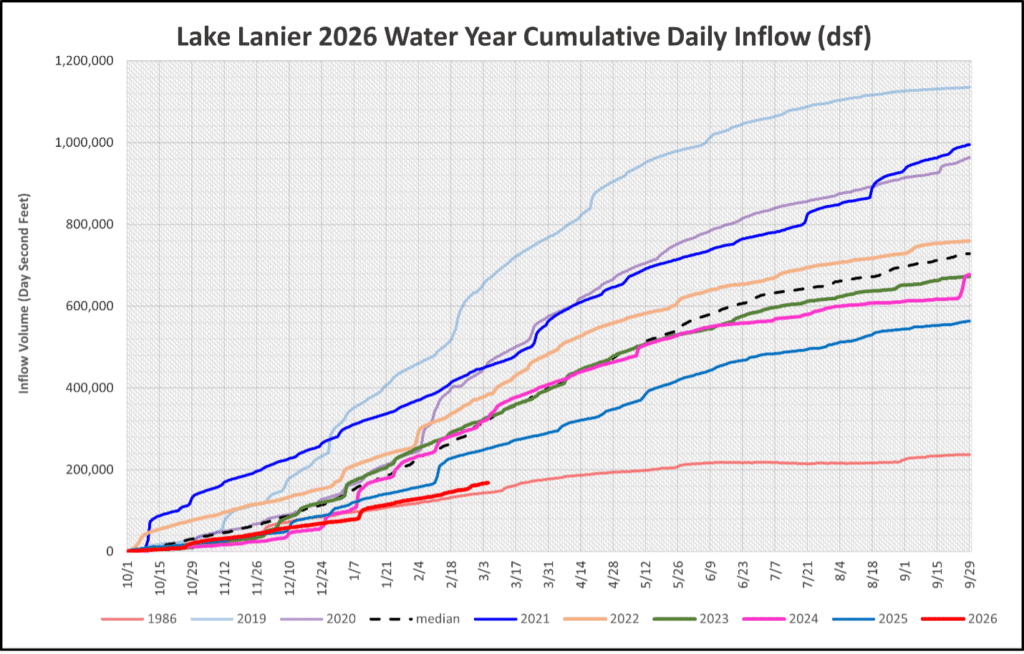
Despite recent rains, Lake Lanier inflows have been well below those in recent years, as the following chart shows.
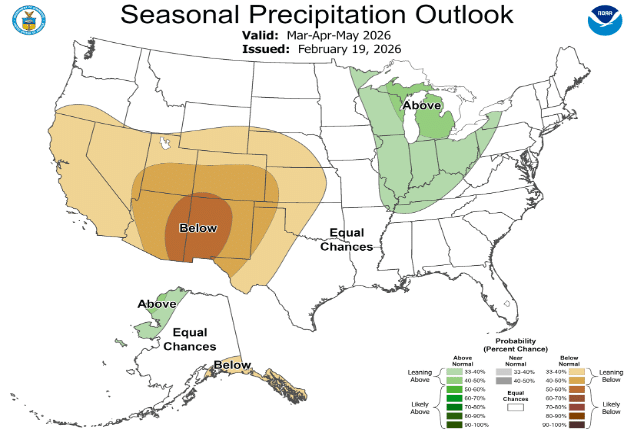
The rainy season for Lanier is largely December through March. The Corps’ operations schedule calls for larger Apalachicola River flows beginning March 1, to support Gulf sturgeon spawning in the Apalachicola River. As a result, that’s when water levels often start to drop at Lanier, a pattern that continues through the hot summer and dry fall months. So, when the lake is only at 1066.25 at the beginning of March, it will require unusual rain patterns or a tropical system bringing heavy rains for the lake to reach full summer pool this year. For what it’s worth, NOAA is forecasting equal chances of above- and below-normal precipitation:
Unfortunately, rainfall in Gainesville since the beginning of the year has been only about 6.75 inches – about half the historical average of about 13.5 inches. But there is some good news: West Point Lake and W. F. George have benefited from recent rains in Middle Georgia and are currently above their summer pool levels. As a result, the Corps has been able to limit Buford Dam releases to only the volume of flow needed to meet local water supply and water quality requirements. If that pattern holds, the Corps should be able to keep more water in Lanier than it usually does.
The Corps publishes an ongoing lake level forecast online, and this is what it showed as of March 9:
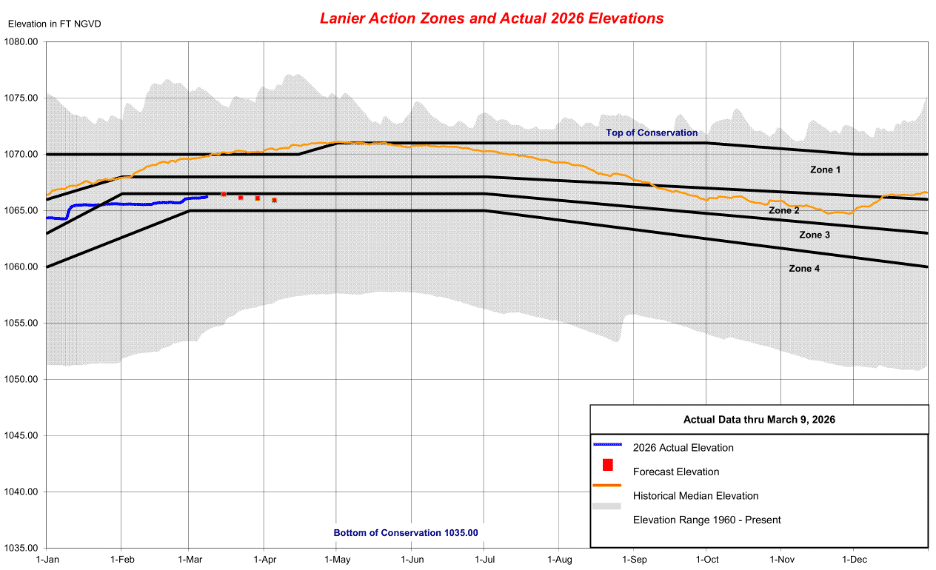
The red dotted line indicates what the Corps thinks will happen to water levels over the next month. If they’re correct, Lanier could be entering Zone 4 by May. While that’s not the news we’d like to get, at least the dry conditions that have led to the current low lake levels have abated, bringing relief and some hope for continuing gains as we head into boating season.
Fortunately, our lake doesn’t have to be full to be fun. Just be mindful of potential underwater obstacles that in recent years would not have impacted your water activities. And praying for rain probably wouldn’t hurt, either.